WHY DO THE HOMEOPATHIC MEDICINES NEED TO TOXIC BUT SMALL?
From his postulation, Hahnemann was convinced enough to believe that if the immune-responses on the left-side of statement (5) can be increased by the means of similar artificial medicinal pathogenic agents, the enhanced immune-responses will quickly take the hold of the invading disease. In fact, Hahnemann’s sole target was to turn statement (5)
From his postulation, Hahnemann was convinced enough to believe that if the immune-responses on the left-side of statement (5) can be increased by the means of similar artificial medicinal pathogenic agents, the enhanced immune-responses will quickly take the hold of the invading disease. In fact, Hahnemann’s sole target was to turn statement (5)
From,
{ ira, irb, irc, ird………. } » d………….(5)
To,
{ ira, irb, irc, ird………. } > d
or, v > d
or, vital force > disease
In order to manipulate therapeutically the organism’s response to multiple similar threats, Hahnemann attempted to add medicine-induced immune-responses on the left-side of statement (5). Hence, he defined that the would-be medicinal substance must fulfill 2 criteria:
First, it must be able to generate symptoms which are similar to the disease symptoms. In other words, it must be able to induce the immune-responses which can take hold of the disease.
Second, it must be strong enough to arouse enormous target immune-responses; but it will easily be subdued by the vital force. You must remember that this property of homeopathic medicines has been criticized by scholars so vehemently.
The severer the poison is, the more it fulfills the first criteria of Homeopathic medicine. According to its dose and usage, a poisonous substance can induce the maximum of immune-responses. The risk of using raw poison as medicine is that it overpowers the vital power severely and often it may threaten life. Also the vital force takes long to subdue it. So, large dose of raw poison could not fulfill the second criteria of Homeopathic medicines. So, Hahnemann introduced the process of ‘succussion’, a method of diluting the raw poison and reducing the severity of the poison.
In naked eyes, it seems quite normal that large doses of poison will induce strong immune-responses and smaller ones will induce weaker one. But how do the miniscule molecules of a poisonous homeopathic medicines induce immune-responses strong enough to cure the disease? This ‘Dose paradox’ of Homeopathic medicines can be solved mathematically with great success.
Suppose, a man is suffering from an abscess on his right leg. Pus is oozing the from abscess for a long time. But it is not healing on its own. If we consider this medical condition in terms of statement (5), we will see that the man’s immune-responses against the abscess are not sufficient enough to heal it. The immune-responses are smaller than the underlying disease on the right side of the equilibrium as following:
v < d
or, { ira, irb, irc, ird………. } < d …………….(7)
Here, the statement (7) denotes that the vital force of the patient is weaker than the underlying diseased condition. It means that the patient's immune-responses are weaker than the underlying diseased condition. So, for the abscess, the statement (5) is as following:
{ Inflammation, Swelling, Pus } » microbial strength
Or, { cytokines, vascular dilatation, Pus} » microbial strength…………... (8)
Suppose, Heaper Sulphur also produces all the three symptoms i.e. Inflammation, Swelling, Pus. So, for Heaper Sulphur, the statement (5) is as following:
{ Inflammation, Swelling, Pus } » Heaper Sulphur
Or, { cytokines, vascular dilatation, Pus} » Heaper Sulphur ……….. (9)
In disease, the equilibrium between the vital force and the disease is as following as in statement (10):
vn » dn …………………..…. (10)
where,
vn= vital force engaging with natural disease
dn= natural disease
When a homeopathic medicines is applied, the vital force intercepts the medicine-induced disease (dmed) in the following manner as in statement (11):
vmed » dmed ……………………. (11)
where,
vmed = vital force engaging with medicinal disease
dmed = medicine-induced disease
Since statement (10) and statement (11) both are simultaneously true during the homeopathic treatment, we can sum statement (10) and statement (11). When homeopathic medicines are applied, medicine-induced disease (dmed) is added to the right-side of this equilibrium and eventually, the vital force on the left-side is split up into two straits (vn and vmed ) to fight off the two disease forces together. So, when homeopathic medicine is applied, the abovementioned equation behaves as following:
vn + vmed » dn + dmed …………………. (12)
Here, since symptoms of natural disease (dn) and medicine-induced disease (dmed) are same, split-up vital forces vn and vmed are qualitatively same. As usually, their immune-responses are also the same.
Hahnemann’s Technique to Enhance the Strength of Non-Lethal Dose of Toxin
Hahnemann required that medicine-induced vital force must be stronger enough to take hold of the progressing disease. But at the same time, the medicinal disease must be the weakest so that the medicine-induced vital force can free itself from the medicine-induced disease and can pay attention to the progressing natural disease. How is it possible to induce the strongest immune-responses with only few molecules (even one molecule) of medicine?
Suppose, each dose of our medicine (Heper Sulphur) contains only one molecule and this molecule of Heper Sulphur causes severe damage to one cell at the route of administration. But surprisingly, one damaged cell releases n number of cytokines, prostaglandins, inflammatory interleukins and growth factors. So, q number of damaged cells will release nxq number of immunity-signaling chemicals.

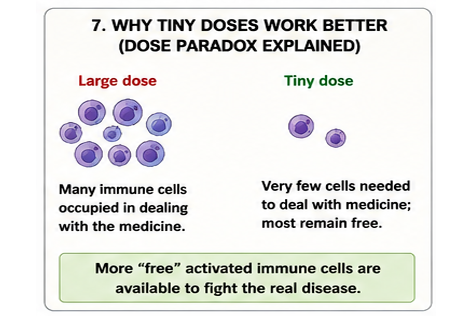
So, out of PQR number of activated immune-cells, P number of immune-cells will engage with P number of Heper Sulphur molecules. Hence, (PQR-P) number of activated immune-cells will remain free to address the progressing disease. There are enormous free activated immune-cells which will moves towards the site of infections and take hold of the disease as illustrated in the following image:


If we consider that the natural immune-response (vn) to the natural disease is absent and the medicine-induced disease (dmed) is very trifle, the statement (12) looks like following:
vn + vmed » dn + dmed …………………. (12)
Or, 0 + vmed » dn + 0
Or, vmed » dn
Through repetition of doses, we can easily increase medicine-induced immune to such a state that will take hold of the disease. That is, we can turn the equilibrium from vmed » dn to vmed > dn
In some recipes, smallness is the only criterion. No matter, how big a hammer you use, you can’t knock common sense into stupid people. In order to make a nuclear bomb explode, you need only a tiny neutron particle. Chain immune-response reaction is a natural biological phenomenon and any quantity of poison, large or small, will trigger it in human body. But only the immune-responses, which are triggered by the smallest doses, can be used more therapeutically.

The sole purpose of minimizing the poisonous dose is to minimize its toxicity and to increase the number of surplus activated immune cells. When the dose is large, most of the activated immune cells get engaged with the medicinal toxicity, and, only few surplus activated immune cells can engage with the disease. But when the medicinal dose is small, the scenario is quite different from the previous one. Few activated immune cells get engaged with the medicinal toxicity, and, most of the activated immune cells remain free to engage with the disease.
👨⚕️ About the Author

Dr. John Michel Warner
BHMS, Italy
Warner Research Lab
Reochini Plaza, Road-3, Italy
📚 Related Articles
-
Warner’s Pharmacodynamic Model of Homeopathy: A Proposed Immunological Interpretation of the Law of Similars
29 Jul 2026
-
HOMEOPATHY VS NUCLEAR SCIENCE: WHICH ONE IS MORE COMPLEX?
27 Jul 2026
-
HOMEOPATHY IN THE FACE OF SEVERE CRITICISMS
27 Jul 2026
-
WHY DO THE HOMEOPATHS POISON THEIR PATIENTS?
27 Jul 2026
-
CHAIN-IMMUNE-REACTION AND THEORETICAL BASIS OF HOMEOPATHY
27 Jul 2026
🆕 Recent Articles
-
ওয়ার্নারের হোমিওপ্যাথির ফার্মাকোডাইনামিক মডেল: সাদৃশ্য সূত্রের আইমিউনোলজিক্যাল ব্যাখ্যার প্রস্তাবিত উপস্থাপনা
Dr. Md. Abdus Samad • 01 Oct 2026
-
Warner’s Pharmacodynamic Model of Homeopathy: A Proposed Immunological Interpretation of the Law of Similars
Dr. John Michel Warner • 29 Jul 2026
-
HOMEOPATHY VS NUCLEAR SCIENCE: WHICH ONE IS MORE COMPLEX?
Dr. John Michel Warner • 27 Jul 2026
-
HOMEOPATHY IN THE FACE OF SEVERE CRITICISMS
Dr. John Michel Warner • 27 Jul 2026
-
WHY DO THE HOMEOPATHS POISON THEIR PATIENTS?
Dr. John Michel Warner • 27 Jul 2026