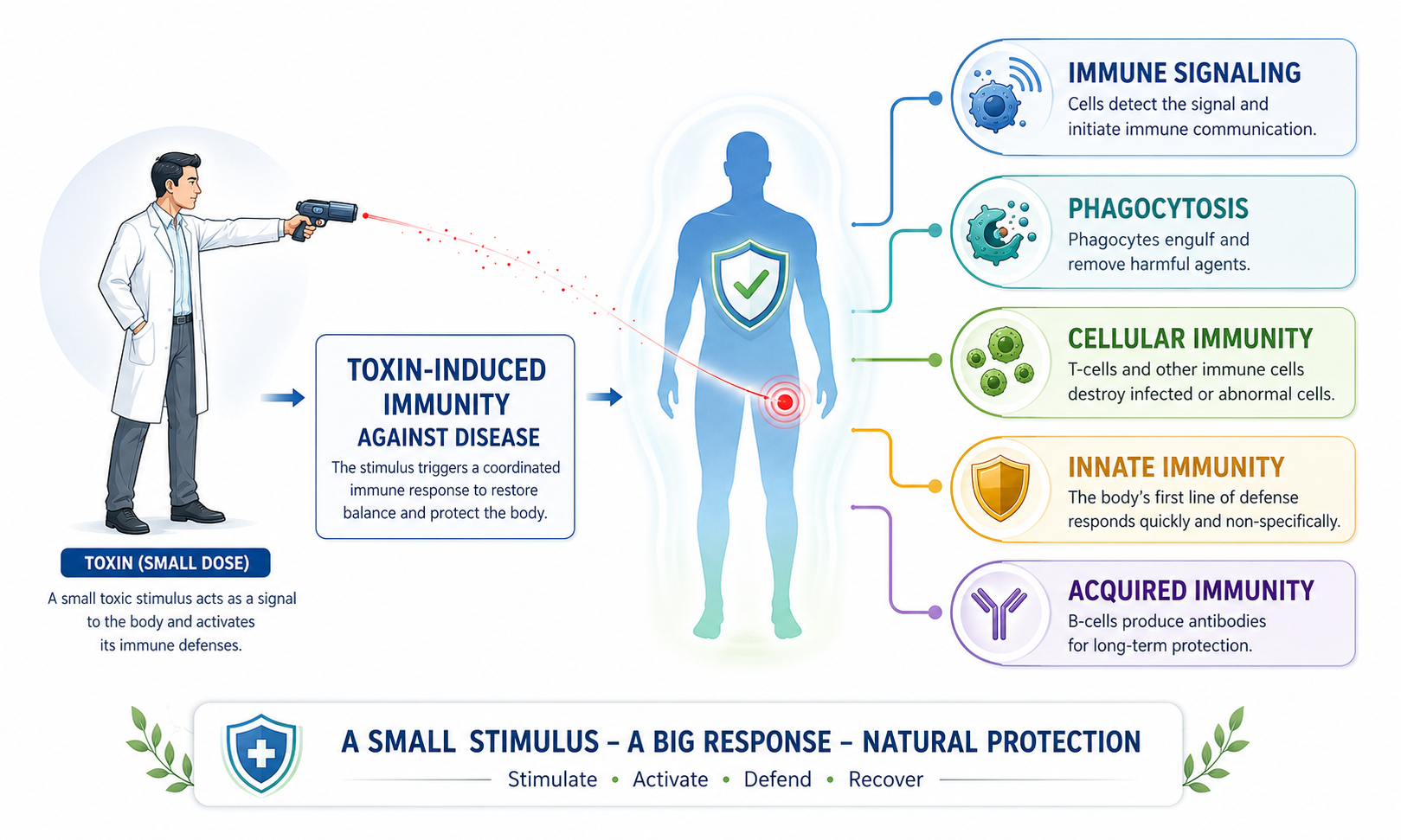
Warner’s Pharmacodynamic Model of Homeopathy: Immune Response, Law of Similars and the Dose Theory
Warner’s Pharmacodynamic Model is a theoretical explanation of homeopathic action that attempts to reinterpret traditional homeopathic concepts—especially Vital Force, the Law of Similars, medicinal disease and small doses—in terms of immune defence and biological amplification.
What Is Warner’s Pharmacodynamic Model?
Warner’s Pharmacodynamic Model is a theoretical explanation of homeopathic action that attempts to reinterpret traditional homeopathic concepts—especially Vital Force, the Law of Similars, medicinal disease and small doses—in terms of immune defence and biological amplification.
According to Warner’s model, a homeopathic medicine does not primarily cure by directly attacking bacteria, viruses, fungi or other causes of disease. Instead, he proposes that an appropriately selected medicine produces a small, controlled biological challenge resembling aspects of the natural disease.
The body responds to this medicinal challenge through defensive mechanisms. Because the medicinal and natural disease patterns are considered similar, Warner argues that their defensive responses may overlap and reinforce one another.
In simplified form:
Natural Disease + Similar Medicinal Challenge
↓
Overlapping Defensive Responses
↓
Amplified Response
↓
Defence Becomes Stronger Than Disease
↓
Recovery
This is Warner’s proposed theoretical framework. It is not an established pharmacodynamic mechanism in mainstream medicine, and its application to homeopathy—particularly highly diluted preparations—has not been established by broad scientific evidence.
Key Takeaways
Warner’s model can be understood through six central ideas:
- Disease occurs when the body’s effective defence is insufficient to overcome the disease challenge.
- Vital Force is interpreted as a collection of defensive and immune responses, rather than simply as a mysterious force.
- A similar medicine introduces a second, controlled challenge that is proposed to recruit defensive pathways resembling those already involved in the natural disease.
- Similarity is important because similar challenges are proposed to evoke overlapping responses.
- Small doses are proposed to stimulate defence while minimising the biological burden caused by the medicine itself.
- A small initial stimulus may theoretically produce a much larger downstream response through biological signalling and amplification, which Warner describes in terms of a Chain Immune Reaction.
The entire theory can therefore be summarised as:
Similarity → Small Challenge → Defensive Activation → Amplification → Recovery
1. How Does Warner Explain Disease?
Warner begins with a simple relationship between the organism’s defensive capacity and the strength of disease.
Let:
v = Vital Force or defensive capacity
d = Disease force
A healthy state can be represented as:
v > d
The organism’s defensive capacity exceeds the disease challenge. A diseased state can be represented as:
v < d
The disease challenge exceeds the organism’s effective defensive response. The therapeutic objective, within Warner’s model, is therefore:
Increase v until v > d
In other words, Warner shifts attention away from directly destroying the disease and towards strengthening or amplifying the organism’s response to it.
2. What Does “Vital Force” Mean in Warner’s Model?
One of the most distinctive features of Warner’s model is his attempt to reinterpret Hahnemann’s concept of the Vital Force using concepts associated with biological defence and immunology.
Rather than treating Vital Force as a single undefined entity, Warner represents it as a collection of responses:
v = {IR₁, IR₂, IR₃, …, IRₙ}
where IR represents an individual immune or defensive response.
Examples may include:
-
inflammation
-
cytokine signalling
-
fever
-
swelling
-
phagocytosis
-
cellular immune responses
-
antibody production
Thus, within Warner’s theoretical framework:
Vital Force ≈ Combined defensive responses of the organism
This reinterpretation attempts to connect traditional homeopathic terminology with concepts from modern physiology and immunology.
It is important, however, to distinguish this interpretation from established immunological definitions. Modern immunology does not define Hahnemann’s Vital Force as the immune system. This equivalence belongs to Warner’s theoretical model.
3. How Does Warner Explain the Law of Similars?
The Law of Similars, traditionally expressed as similia similibus curentur or “like cures like,” is central to homeopathic theory.
Warner attempts to explain similarity through overlapping defensive responses. Suppose a natural disease produces a pattern involving:
Fever + Inflammation + Swelling
A substance capable of producing a sufficiently similar pattern is then selected according to the homeopathic principle of similarity.
Warner’s proposed sequence is:
Natural Disease
↓
Characteristic Physiological Disturbance
↓
Particular Defensive Response
and:
Similar Medicine
↓
Similar Physiological Disturbance
↓
Similar or Overlapping Defensive Response
According to the model, similarity matters because two qualitatively similar challenges may recruit overlapping defensive pathways.
Warner therefore interprets the Law of Similars not merely as a similarity between symptoms, but as a proposed similarity between the biological responses associated with the natural disease and the medicine.
4. What Is “Medicinal Disease” in Warner’s Model?
Warner distinguishes between the natural disease and a medicine-induced challenge, sometimes described in traditional homeopathic terminology as a medicinal disease or artificial disease.
Let:
dₙ = Natural disease
dₘₑd = Medicine-induced challenge
The body’s corresponding responses can be represented as:
vₙ = Defensive response to the natural disease
vₘₑd = Defensive response to the medicinal challenge
The organism is therefore dealing conceptually with:
dₙ + dₘₑd
while generating:
vₙ + vₘₑd
Warner’s hypothesis is that when dₙ and dₘₑd are qualitatively similar, vₙ and vₘₑd may also overlap.
The proposed result is not simply two independent responses, but a reinforced defensive reaction directed through similar pathways.
In simplified form:
Natural Disease
+
Similar Medicinal Challenge
↓
Overlapping Defensive Responses
↓
Reinforcement
5. Why Are Similar Challenges Important?
This leads to one of the central propositions of Warner’s Pharmacodynamic Model:
If the organism encounters two qualitatively similar challenges, Warner proposes that it may respond to both through overlapping defensive strategies.
The relationship can be visualised as:
Similar Challenges
↓
Similar Defensive Pathways
↓
Overlapping Response
↓
Reinforcement
By contrast:
Different Challenges
↓
Different or Less-Overlapping Responses
Within Warner’s interpretation, this provides a proposed biological explanation for why the homeopathic medicine must be similar to the natural disease rather than simply being any substance capable of stimulating immunity.
Similarity, in this model, is supposed to provide specificity to the defensive stimulation.
This is Warner’s theoretical proposal rather than an established principle of immunology.
6. Why Does Warner Discuss Poisons and Toxic Substances?
Warner gives particular importance to substances capable of producing toxic effects because toxic exposure can produce biological disturbance and provoke defensive responses.
His reasoning can be simplified into two observations:
Toxic substance
↓
Biological disturbance or tissue injury
and:
Biological disturbance
↓
Defensive and inflammatory responses
Traditional homeopathic substances associated with toxicity include Aconite, Rhus toxicodendron and Nux vomica. The dose then becomes critical.
A sufficiently large exposure may cause:
Significant Toxicity
↓
Tissue Injury
↓
Potential Harm
Warner instead proposes:
Small Controlled Challenge
↓
Limited Disturbance
↓
Defensive Activation
His proposed therapeutic objective is therefore to provoke a defensive response while minimising the biological burden created by the medicinal substance.
This should not be interpreted as a general medical recommendation to consume poisonous substances. Toxicity depends on the substance, dose, route of exposure and many other factors.
7. Why Does Warner Propose Small Doses?
Warner uses his model to address what can be called the Dose Paradox:
If a medicine works by creating a challenge, why not use a larger challenge to produce a stronger response?
His proposed answer is that increasing the dose also increases the burden created by the medicine itself.
Large Dose
↓
Large Medicinal Challenge
↓
Greater Toxicity
↓
Greater Defensive Resources Required to Manage the Medicine
And,
Small Dose
↓
Small Medicinal Challenge
↓
Limited Medicinal Burden
↓
Defensive Activation
↓
Less Response Required to Manage the Medicine Itself
Warner therefore proposes a theoretical principle of:
Maximum useful defensive stimulation with minimum medicinal burden
In his framework, a small stimulus is preferable because the medicine is intended to trigger a defensive process rather than become a major toxic challenge itself.
This explanation is part of Warner’s model and should not be interpreted as established evidence for the efficacy or mechanism of highly diluted homeopathic preparations.
8. What Is Warner’s “Chain Immune Reaction”?
One of the most important concepts in Warner’s pharmacodynamic theory is the proposed Chain Immune Reaction.
Warner argues that the magnitude of the initial stimulus does not necessarily have to equal the magnitude of the final biological response.
A small initial event may trigger signalling processes that recruit many additional cells and pathways.
His proposed sequence can be represented as:
Small Medicinal Stimulus
↓
Limited Cellular Disturbance
↓
Release of Biological Signals
↓
Recruitment and Activation of Defensive Cells
↓
Further Signalling
↓
Expansion of the Response
↓
Large Defensive Reaction
Warner discusses signalling substances such as:
-
cytokines
-
prostaglandins
-
interleukins
-
growth factors
The general concept that biological signalling can amplify an initial stimulus is well established in biology.
However, the existence of biological amplification does not by itself demonstrate that homeopathic preparations initiate the particular therapeutic chain reaction proposed by Warner.
That distinction is essential when evaluating the model scientifically.
9. How Does Warner Explain Immune Amplification Mathematically?
Warner uses a simplified mathematical idea to illustrate biological amplification.
Suppose one medicinal unit initiates activation involving:
P immune cells
If Q medicinal units participate, the response might conceptually be represented as:
P × Q
If the response then undergoes further amplification through R stages:
P × Q × R
The purpose of this representation is not to provide a validated quantitative pharmacological equation.
Rather, it illustrates Warner’s central idea:
A relatively small initiating stimulus may theoretically produce a much larger downstream biological response.
In Warner’s model, only part of this response would be required to deal with the medicinal challenge itself, while the reinforced defensive response would also act against the similar natural disease.
Again, this is a conceptual model rather than an experimentally validated mathematical description of homeopathic pharmacodynamics.
10. What Is the Complete Warner Pharmacodynamic Pathway?
Warner’s proposed mechanism of homeopathic action can be summarised as the following sequence:
HOMEOPATHIC MEDICINE
↓
Small Similar Medicinal Challenge
↓
Limited Biological Disturbance
↓
Release of Signalling Molecules
↓
Activation of Defensive Mechanisms
↓
Innate Immune Response
↓
Adaptive Immune Response
↓
Amplification of Defensive Activity
↓
Overlap with the Response to Natural Disease
↓
Effective Defence Exceeds Disease Challenge
↓
RECOVERY
Using Warner’s simplified notation:
Initially:
v < d
The disease challenge exceeds the organism’s effective defence.
After the proposed medicinal stimulation:
v ↑
If defensive activity becomes sufficiently strong:
v > d
Warner associates this transition with recovery.
11. How Does Warner Reinterpret Hahnemann’s Law of Similars?
Warner’s interpretation can be condensed into a five-stage hypothesis:
1. Natural disease creates a characteristic disturbance.
↓
2. A similar medicine creates a smaller, qualitatively similar disturbance.
↓
3. Both challenges recruit overlapping defensive mechanisms.
↓
4. The medicinal challenge amplifies the relevant defensive response.
↓
5. The combined response becomes sufficient to overcome the natural disease.
In this interpretation, like cures like becomes a proposed principle of biological response matching.
Similarity is therefore supposed to determine which defensive pathways are stimulated, while the small dose is intended to determine how much additional burden is imposed on the organism.
12. How Is Warner’s Model Different from Conventional Pharmacodynamics?
In mainstream pharmacology, pharmacodynamics refers broadly to the effects of a drug on the body and the mechanisms responsible for those effects.
A conventional pharmacodynamic pathway might look like:
Drug
↓
Molecular Target
↓
Receptor / Enzyme / Ion Channel / Other Interaction
↓
Biochemical or Cellular Change
↓
Physiological Effect
↓
Clinical Effect
Examples include:
-
receptor agonism and antagonism
-
enzyme inhibition
-
ion-channel modulation
-
transporter interactions
-
modulation of cellular signalling pathways
Warner proposes a different primary pathway:
Similar Medicinal Challenge
↓
Biological Disturbance
↓
Defensive Signalling
↓
Immune Activation
↓
Amplification
↓
Reinforcement of the Response to Disease
The fundamental difference is therefore:
Conventional pharmacodynamics:
Drug → Molecular target → Biological effect
Warner’s proposed model:
Similar medicinal challenge → Defensive activation → Amplification → Reinforced response to disease
13. Is Warner’s Pharmacodynamic Model Scientifically Proven?
No. Warner’s proposed mechanism should be regarded as a theoretical interpretation rather than an established pharmacodynamic mechanism.
Several biological concepts appearing in the model are well established individually. These include:
-
cytokine signalling
-
inflammation
-
phagocytosis
-
innate immunity
-
adaptive immunity
-
cellular signalling
-
biological amplification
However, the scientific validity of these individual processes does not establish the complete mechanism proposed by Warner.
Specifically, it has not been established by broad scientific evidence that:
A homeopathically similar medicinal challenge
↓
selectively recruits disease-relevant immune pathways
↓
produces Warner’s proposed amplification
↓
and thereby explains homeopathic therapeutic effects
The question becomes particularly important with highly diluted homeopathic preparations, including dilutions in which little or none of the original substance may remain.
Therefore, Warner’s model should be discussed as a hypothesis or theoretical framework, not as a demonstrated mechanism of action.
14. Why Is Warner’s Model Historically Interesting?
Warner’s framework is interesting because it attempts to translate traditional homeopathic concepts into the vocabulary of modern biology.
Traditional homeopathic terminology can be represented as:
Vital Force
↓
Natural Disease
↓
Artificial or Medicinal Disease
↓
Similarity
↓
Small Dose
↓
Recovery
Warner attempts to reinterpret this as:
Biological Defence
↓
Natural Disease Challenge
↓
Similar Medicinal Challenge
↓
Overlapping Defensive Responses
↓
Biological Amplification
↓
Recovery
The significance of the model therefore lies partly in its attempt to construct a conceptual bridge between Hahnemannian homeopathic theory and modern immunological terminology.
Whether that bridge accurately represents biological reality is a separate question that requires experimental evidence.
Warner’s Pharmacodynamic Model in One Diagram
NATURAL DISEASE
↓
Insufficient Defensive Response
v < d
↓
SIMILAR HOMEOPATHIC MEDICINE
↓
Small Medicinal Challenge
↓
Biological Disturbance
↓
Cytokines and Other Signalling Processes
↓
Defensive / Immune Activation
↓
Proposed Chain Immune Reaction
↓
Amplified and Overlapping Defensive Response
↓
v ↑
↓
v > d
↓
RECOVERY
Warner’s Pharmacodynamic Model in One Sentence
Warner’s Pharmacodynamic Model proposes that a small medicinal challenge resembling the natural disease may activate overlapping defensive pathways and amplify the organism’s response until its effective defence becomes sufficient to overcome the disease.
This is a theoretical explanation of homeopathic action and is not an established mechanism in mainstream biomedical science.
Frequently Asked Questions
What is Warner’s Pharmacodynamic Model?
Warner’s Pharmacodynamic Model is a theoretical explanation of homeopathy in which a small, disease-similar medicinal challenge is proposed to stimulate defensive responses that overlap with those already responding to the natural disease.
How does Warner explain Vital Force?
Warner attempts to reinterpret Hahnemann’s Vital Force as a collection of biological defensive responses, including inflammation, immune signalling, phagocytosis, cellular immunity and antibody responses. This is Warner’s interpretation, not the standard scientific definition of Vital Force.
How does Warner explain the Law of Similars?
Warner proposes that similar disease and medicinal challenges may activate overlapping defensive pathways. The medicinal response could therefore reinforce the response already directed against the natural disease.
What is medicinal disease?
In homeopathic theory, medicinal or artificial disease refers to the disturbance produced by a medicine. Warner interprets this disturbance as a second biological challenge that, when similar to the natural disease, may provoke overlapping defensive responses.
Why does Warner propose using small doses?
Warner argues that the medicinal challenge should be sufficient to stimulate a defensive response but small enough to minimise the biological burden caused by the medicine itself.
What is the Chain Immune Reaction?
The Chain Immune Reaction is Warner’s proposed amplification mechanism in which a small medicinal stimulus initiates signalling events that activate increasingly larger defensive responses.
Is the Chain Immune Reaction established immunology?
Biological signalling and amplification are established phenomena, but Warner’s specific claim that homeopathic medicines use such a chain reaction to reinforce disease-specific defensive responses has not been established by mainstream biomedical evidence.
Is Warner’s Pharmacodynamic Model scientifically accepted?
No. It is best described as a theoretical or hypothetical model. Although it uses terminology from established immunology, the complete proposed mechanism of homeopathic action is not accepted as an experimentally established pharmacodynamic model in mainstream biomedical science.
Conclusion
Warner’s Pharmacodynamic Model represents an attempt to explain traditional homeopathic principles through the language of biological defence, immunology and pharmacodynamics.
Its central proposal is:
Natural Disease
+
Small Similar Medicinal Challenge
↓
Overlapping Defensive Responses
↓
Biological Amplification
↓
Defence Becomes Greater Than Disease
↓
Recovery
Within this framework, the Vital Force becomes a collection of defensive responses; the Law of Similars becomes a proposed mechanism for matching defensive pathways; the small dose is intended to stimulate without imposing excessive toxicity; and the Chain Immune Reaction provides Warner’s proposed explanation for how a small stimulus could produce a larger biological response.
The model is historically and conceptually interesting because it attempts to reinterpret Hahnemannian ideas using terminology from modern immunology.
However, a clear distinction must be maintained between Warner’s theoretical interpretation and scientifically established pharmacodynamics. The immunological processes referenced by the model are real biological phenomena, but their existence does not demonstrate Warner’s proposed mechanism of homeopathic action.
Further experimental evidence would be required to establish whether the relationships proposed by the model occur in biological systems and whether they can explain clinical effects attributed to homeopathic preparations.
Editorial and Scientific Note
This article explains Warner’s proposed pharmacodynamic model of homeopathy for educational, theoretical and historical discussion.
Descriptions of immune activation, medicinal challenge, biological amplification and the Law of Similars represent the model being discussed unless explicitly identified as established biomedical knowledge.
The article does not claim that Warner’s proposed mechanism has been scientifically validated and should not be interpreted as medical advice or as guidance for the use of toxic substances or homeopathic preparations.
👨⚕️ About the Author

Dr. John Michel Warner
BHMS, Italy
Warner Research Lab
Reochini Plaza, Road-3, Italy
📚 Related Articles
-
Warner’s Pharmacodynamic Model of Homeopathy: A Proposed Immunological Interpretation of the Law of Similars
29 Jul 2026
-
HOMEOPATHY VS NUCLEAR SCIENCE: WHICH ONE IS MORE COMPLEX?
27 Jul 2026
-
HOMEOPATHY IN THE FACE OF SEVERE CRITICISMS
27 Jul 2026
-
WHY DO THE HOMEOPATHS POISON THEIR PATIENTS?
27 Jul 2026
-
CHAIN-IMMUNE-REACTION AND THEORETICAL BASIS OF HOMEOPATHY
27 Jul 2026
🆕 Recent Articles
-
Warner’s Pharmacodynamic Model of Homeopathy: A Proposed Immunological Interpretation of the Law of Similars
Dr. John Michel Warner • 29 Jul 2026
-
HOMEOPATHY VS NUCLEAR SCIENCE: WHICH ONE IS MORE COMPLEX?
Dr. John Michel Warner • 27 Jul 2026
-
HOMEOPATHY IN THE FACE OF SEVERE CRITICISMS
Dr. John Michel Warner • 27 Jul 2026
-
WHY DO THE HOMEOPATHS POISON THEIR PATIENTS?
Dr. John Michel Warner • 27 Jul 2026
-
CHAIN-IMMUNE-REACTION AND THEORETICAL BASIS OF HOMEOPATHY
Dr. John Michel Warner • 27 Jul 2026